
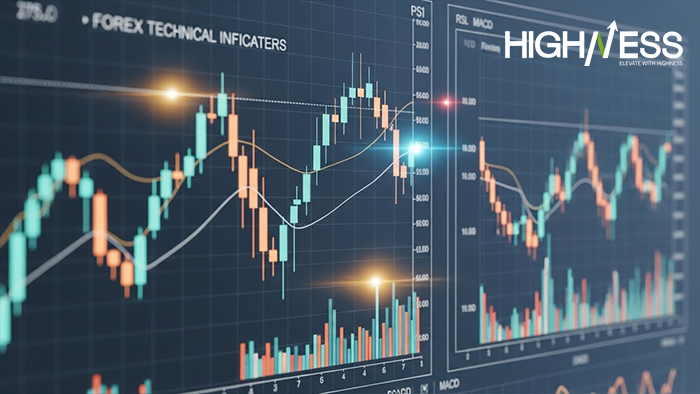
Technical indicators are analytical tools used in forex trading to interpret price movements, identify trends, and forecast future market behavior. Traders rely on these indicators to make informed decisions on when to open or close trades. This article provides a detailed explanation of the most commonly used technical indicators in forex and how to use them effectively for optimal results.
What Are Technical Indicators?
Technical indicators are mathematical tools based on formulas and software that analyze historical market data, such as prices and trading volumes, to provide signals that assist traders in making trading decisions. Indicators are divided into two main types:
Lagging Indicators: Focus on tracking past trends and confirming them.
Leading Indicators: Aim to predict future market movements.
Types of Technical Indicators in Forex
These indicators help identify the market direction: upward, downward, or sideways.
Key Trend Indicators:
Moving Averages (MA):
What is it? An average of a currency pair's price over a specific period.
Types:
Simple Moving Average (SMA): average of prices over a set period.
Exponential Moving Average (EMA): gives more weight to recent prices.
Usage:
Price above MA → Uptrend.
Price below MA → Downtrend.
Average Directional Index (ADX):
What is it? Measures trend strength without indicating direction.
Usage:
Above 25 → Strong trend.
Below 20 → Sideways market.
Measure the speed and strength of price movements.
Key Momentum Indicators:
Relative Strength Index (RSI):
Range 0–100; shows overbought or oversold conditions.
Usage: >70 → Overbought (possible drop), <30 → Oversold (possible rise).
Stochastic Oscillator:
Measures relationship between closing price and high/low over time.
Usage: >80 → Overbought, <20 → Oversold.
MACD (Moving Average Convergence Divergence):
Compares two moving averages (short & long) to identify momentum.
Usage: MACD above signal line → Buy, MACD below signal line → Sell.
Measure trading volume to gauge trend strength.
Key Volume Indicators:
Volume Indicator:
Usage: Rising volume with price → strong trend, falling volume → weak trend.
Money Flow Index (MFI):
Measures money inflow/outflow.
Usage: >80 → Overbought, <20 → Oversold.
Used in sideways markets to find entry/exit points.
Key Oscillators:
Bollinger Bands:
Three lines: moving average and two standard deviations.
Usage: Near upper band → sell, near lower band → buy.
Commodity Channel Index (CCI):
Measures deviation from average price.
Usage: >+100 → strong upward trend, <-100 → strong downward trend.
Identify potential reversal levels.
Key Indicators:
Fibonacci Levels: 38.2%, 50%, 61.8% → common reversal levels.
Pivot Points: daily reversal levels based on previous close.
How to Choose the Right Technical Indicators
Define your strategy: trend-based, momentum-based, or support/resistance.
Avoid too many indicators: excessive indicators can cause conflicting signals.
Test indicators: use a demo account first.
Combine indicators: mix multiple indicators for better signals.
Conclusion
Technical indicators are powerful tools for analyzing markets and making informed trading decisions. Understanding how they work and choosing the right ones for your needs can enhance your performance. Always use indicators as part of a broader strategy, including risk management and fundamental analysis.
Discover why over 25.000 live trading accounts trust Highness, and join the community of successful traders today.


 KU
KU